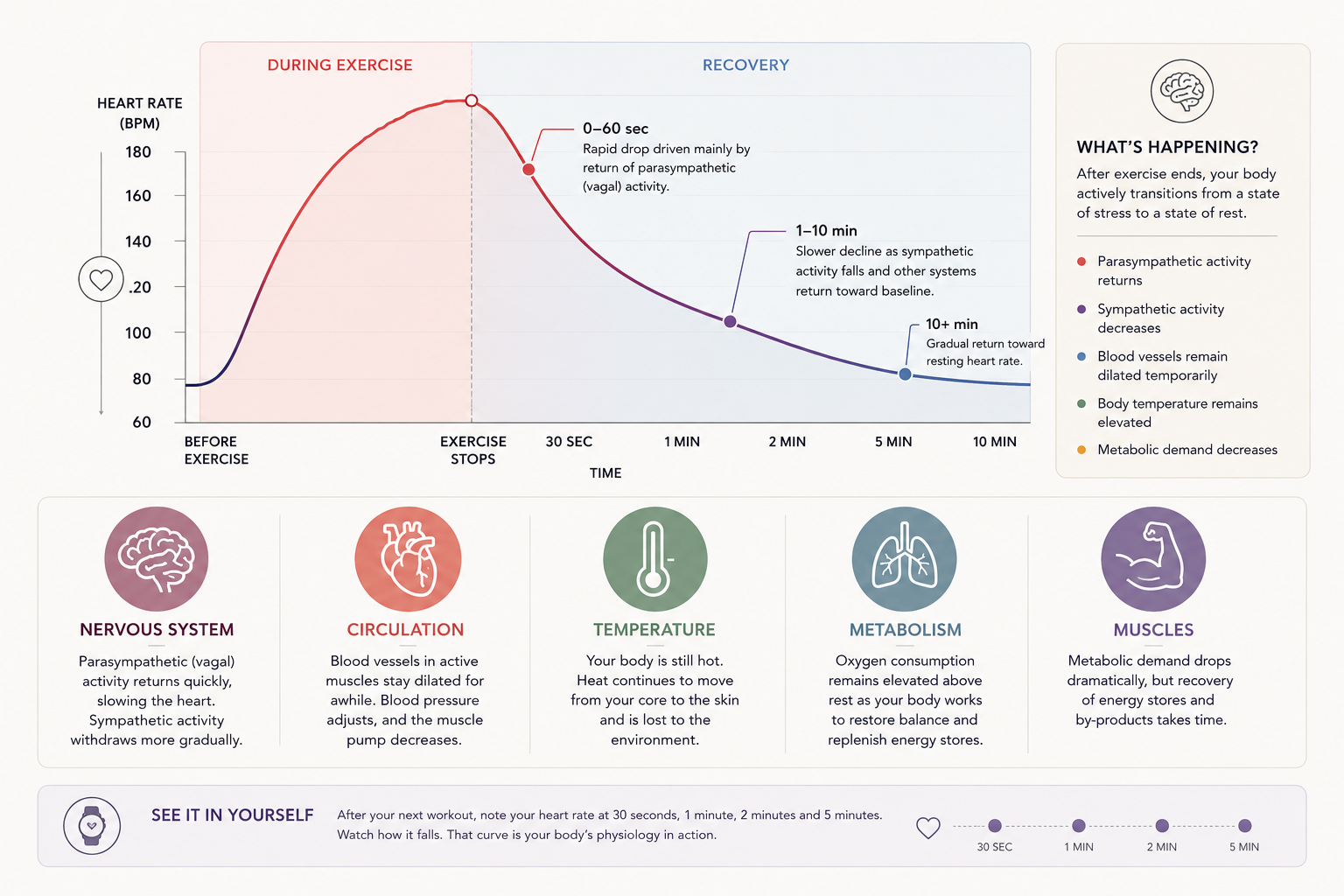
Exercise may have stopped. Your cardiovascular system hasn’t.
You finish your run, step off the bike, or put down the weights. Your muscles are no longer demanding the same amount of oxygen, but your heart is still beating much faster than it was before you started.
Why?
Because stopping exercise is instantaneous. Recovering from exercise is not.
Your nervous system has to shift back toward rest. Blood pressure and blood flow have to be redistributed. Your body may still be carrying extra heat and multiple physiological systems that were activated during exercise now have to gradually return toward their resting state.
Recovery is not simply the absence of exercise. It is an active physiological process.
THE SHORT ANSWER
Your heart rate remains elevated after exercise because your body cannot immediately switch from exercise to rest.
During the first moments of recovery, parasympathetic - or vagal activity - returns and begins slowing the heart. Sympathetic influence also decreases as recovery progresses. At the same time, blood vessels in previously active muscles can remain dilated, body temperature may remain elevated, and your cardiovascular system is still adjusting blood pressure and circulation.
The heart-rate trace you see after exercise is therefore a visible consequence of your body transitioning back toward homeostasis (basically back to baseline).
Your nervous system has to switch gears
Your heart does not decide by itself how quickly to beat.
One of its major controllers is the autonomic nervous system.
This is the part of your nervous system that regulates many processes you do not consciously control, including heart rate, blood pressure, digestion and body temperature.
Two branches are particularly important:
The sympathetic nervous system helps support the increased cardiovascular demands of exercise.
The parasympathetic nervous system, particularly through the vagus nerve, exerts a powerful slowing influence on the heart.
At the beginning of exercise, one of the fastest ways to increase heart rate is actually to remove some of that parasympathetic brake.
As exercise intensity rises, sympathetic activation becomes increasingly important, helping increase heart rate and the force of cardiac contraction.
When exercise stops, the process begins to reverse.
Classic experiments using pharmacological blockade of the autonomic nervous system demonstrated that the rapid decline in heart rate immediately after exercise is strongly influenced by the return of vagal activity. [1,2]
Later stages of recovery increasingly reflect withdrawal of sympathetic influence as well. So your heart is not simply “slowing down.”
Your autonomic nervous system is actively changing the balance of signals reaching it.
Heart-rate recovery happens in phases
If you plot heart rate after exercise, it does not usually decline at a perfectly constant rate.
The first part of the curve is often relatively steep. Then the decline becomes progressively slower. Researchers describe this as having a fast and a slower component of heart-rate recovery.
The rapid early phase appears to be driven predominantly by parasympathetic reactivation.
The slower phase is influenced more strongly by sympathetic withdrawal and by other processes occurring during recovery, including thermoregulation and changes in cardiovascular reflexes [3].
This is why the first minute after exercise has received so much attention in exercise physiology and clinical research. The reduction in heart rate following exercise is known as heart-rate recovery, or HRR.
But your heart is only one part of the story
Your circulation also looks very different immediately after exercise than it does at true rest.
During exercise, blood vessels supplying active skeletal muscle dilate. That dramatically increases blood flow to the tissues performing the work.
When exercise stops, this vasodilation does not disappear immediately.
Blood vessels in previously active muscle can remain dilated during recovery, contributing to a phenomenon called post-exercise hypotension - a temporary reduction in arterial blood pressure following a bout of exercise. [4]
At the same time, there is another important change.
When your muscles were contracting rhythmically, they were helping push blood through the veins back toward the heart - a phenomenon commonly referred to as the muscle pump. If you stop moving abruptly, that assistance decreases.
Your cardiovascular system therefore has to manage a new situation: lower metabolic demand, persistent vasodilation and less help returning blood toward the heart.
That is one reason standing completely still immediately after hard exercise can sometimes make people feel light-headed.
Your body may still be carrying heat
Your muscles are not particularly efficient machines.
A large proportion of the energy released during exercise eventually becomes heat. As exercise continues, body temperature can therefore rise substantially.
And when exercise stops, that stored heat does not disappear immediately.
Research has shown that core and muscle temperatures can remain elevated during recovery.
Interestingly, sweating and skin blood flow can begin falling relatively quickly after exercise even while the body is still storing additional heat. [5]
This means recovery is not simply exercise physiology running backward.The body's regulatory systems are moving into a new physiological state.
Heart rate is recovering while circulation, temperature regulation and autonomic control are all being adjusted at the same time.
Does a faster heart-rate recovery mean you are fitter?
Sometimes — but this needs CONTEXT.
Those athletes you see -especially endurance-trained athletes - often demonstrate faster vagally mediated heart-rate recovery than untrained individuals, and training can influence autonomic control of the heart. [2]
Heart-rate recovery has also been studied clinically because unusually slow recovery during standardized exercise testing has been associated with cardiovascular risk. But that does NOT mean you should take a number from a medical exercise test and apply it directly to the workout recorded by your smartwatch.
How heart-rate recovery is measured matters.
It can change depending on:
Clinical thresholds come from standardized testing conditions.
One important thing to note is that your post-run Apple Watch number is not automatically a clinical test.
Heart-rate recovery is therefore much more useful for our purposes as a way of understanding physiology rather than diagnosing yourself.
SEE IT IN YOURSELF
Watch your heart recover
You do not need a physiology laboratory to observe this process.
If you already monitor your heart rate during exercise, look at what happens when your next workout ends.
After exercise, note your heart rate at:
End of exercise: _____ bpm
30 seconds: _____ bpm
1 minute: _____ bpm
2 minutes: _____ bpm
5 minutes: _____ bpm
Then look at the shape of the curve.
Don't worry about whether your number is supposedly “good” or “bad.”
Instead, you can ask:
How quickly does my heart rate initially fall?
That steep early decline is where parasympathetic reactivation becomes especially visible.
Then notice how the curve begins to flatten as your heart rate moves progressively closer to rest.
You are watching your autonomic nervous system change state in real time.
I know it's tempting, but don't turn your physiology into a score
The temptation with wearable data is to immediately ask: Is my recovery good?
But what you are actually doing is skipping a more interesting question: What am I actually seeing?
Try observing heart-rate recovery after different types of exercise.
For example:
Easy aerobic exercise VERSUS hard intervals or exercise in a cool environment VERSUS
exercise in the heat...and you might actually notice that the curves are not identical.
That's because heart-rate recovery is not controlled by a single switch.
Exercise intensity, temperature, blood pressure regulation, autonomic activity and recovery conditions can all influence what happens after you stop.
Your wearable can therefore become less of a scoreboard and more of a window into your physiology.
WHAT ARE YOU MEASURING WITH?
Before interpreting heart-rate data, it helps to understand how your device measures it.
Chest straps
Most heart-rate chest straps use electrodes positioned against the chest to detect the electrical activity associated with each heartbeat. This makes their measurement principle much closer to electrocardiography than that of most smartwatches. In studies comparing consumer heart-rate monitors with ECG, electrode-based chest straps have generally shown extremely high agreement with the ECG reference[6]. For situations where precise beat-to-beat timing matters, chest-based electrical measurement is generally preferable to wrist optical measurement.
Smartwatches and fitness watches
Most modern watches measure heart rate using photoplethysmography, usually shortened to PPG.
How does that work?
LEDs shine light into the skin.As blood volume changes with each heartbeat, the amount of light absorbed and reflected also changes, then the algorithms use that optical signal to estimate your pulse.
A systematic review and meta-analysis covering 44 studies found relatively small average differences between wrist-worn devices and criterion heart-rate measurements during rest, sleep and treadmill activities. However, the accuracy was less consistent during activities such as cycling and resistance exercise. [7]
That tells us something important:
Wearable accuracy depends on context.
The Movement matters.
The Sensor placement matters.
The type of exercise matters.
And individual devices use different hardware and algorithms.
So which device should you use?
For simply observing how your heart rate responds to exercise and then gradually falls afterward:
The device you already own may be enough.
You do not need to buy a research-grade monitor just to explore your physiology.
If you want more precise heart-rate measurement during rapidly changing exercise — or accurate beat-to-beat timing - an electrode chest strap is generally the stronger consumer option.
If you are using a smartwatch, focus on the overall pattern rather than assuming that every individual value is perfectly accurate.
A strange reading for five seconds does not necessarily mean your heart suddenly behaved strangely.
Sometimes it means the sensor did.
TRY THIS NEXT
Once you understand your own recovery curve, start asking questions.
Don't search for the result you think you are supposed to see.
Observe first, Then ask why.
The Physiology Edit provides educational information about human physiology and exercise. It is not intended to provide individual medical advice or diagnosis.