What Does Your VO₂max Actually Tell You?
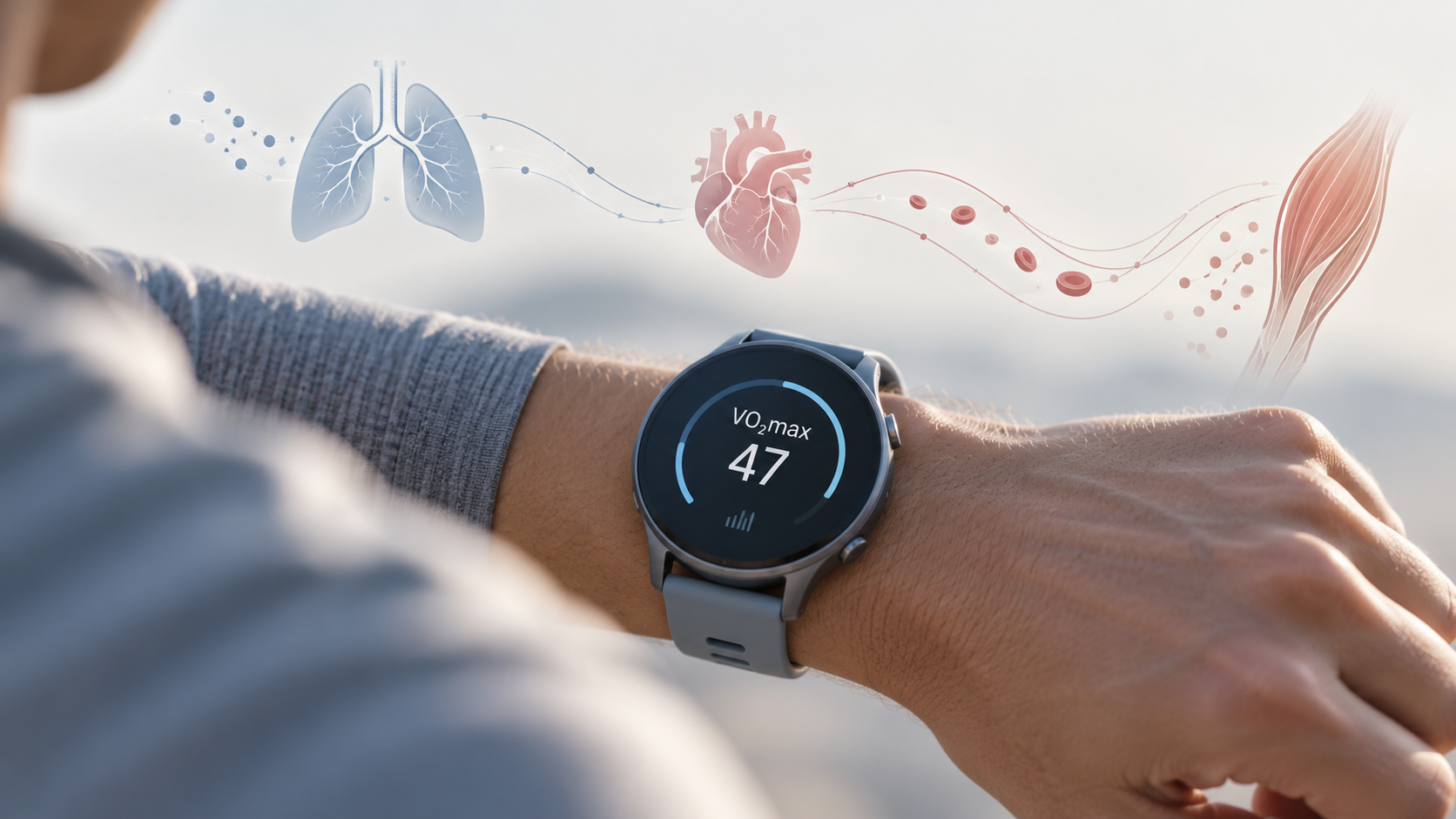
Your watch calls it “cardio fitness.” But VO₂max is really a window into how your lungs, heart, blood and muscles work together when exercise gets hard.
You finish a run, look down at your watch, and there it is: VO₂max: 47. Okay. Is that good?
Does it mean you’re fit? Does it tell you how fast you can run? Why is your friend’s number higher even though you regularly beat them?
And maybe the strangest question:
How can your watch possibly know how much oxygen your body is using when it never measured your oxygen at all?
Then one morning the number drops. 47 becomes 44. "Did I somehow lose months of fitness overnight?", you think out loud.
Probably not.
VO₂max is one of the most recognizable numbers in exercise physiology—and now that it lives on our wrists, it may also be one of the most misunderstood. So what is it actually telling you?
First: what exactly is VO₂max?
VO₂max stands for maximal oxygen uptake.
Put simply, it is the greatest amount of oxygen your body can take in, transport and use during intense exercise. And the part that's underline in this sentence is what really matters and that is because VO₂max is often described as a measure of your “lungs” or your “cardio.” It’s much bigger than either one. See for oxygen to eventually help your muscles produce energy, it has to travel through an entire physiological chain:
Air → lungs → blood → heart → circulation → muscle → mitochondria
Your lungs bring oxygen into the body.
Your blood carries it.
Your heart pumps that oxygen-rich blood toward working muscle.
Blood vessels (circulation) distribute it.
Your muscle extracts it.
And your mitochondria ultimately use oxygen to help produce the energy required to keep you moving.
VO₂max reflects how well that entire system can work when you push it toward its limit [1,2]. That is why the proper term is cardiorespiratory fitness. SO its simply a heart score, and its definitely not just a lung score.
So what actually limits your VO₂max?
I love this part, because this is where physiology gets FUN!
If you have healthy lungs, they can usually bring a lot of oxygen into your body. The bigger challenge during maximal exercise is often getting enough of that oxygen to the muscles quickly enough.
Your heart can only pump so much blood every minute AND your blood can only carry so much oxygen. And your muscles can only extract and use what arrives.
One of the simplest ways exercise physiologists think about this is through the Fick principle:
VO₂ = cardiac output × oxygen extraction
Or, translated into normal language LOL:
how much oxygen you use depends on how much oxygen-rich blood your heart delivers and how much oxygen your tissues remove from that blood.
In healthy humans, the cardiovascular system plays a major role in setting that upper limit [2,3]. So when someone has an impressive VO₂max, what you are really looking at is an impressive oxygen transport system. In other words, chill, you can get there too.
What does “47” actually mean?
VO₂max is commonly reported as:
mL of oxygen / kg of body mass / minute
So a VO₂max of 47 mL/kg/min means that, at maximal exercise, your body can use roughly 47 millilitres of oxygen per kilogram of body mass every minute. I know units are just units, but “per kilogram” really matters in this context.
If you change body mass, your relative VO₂max can change even if your absolute ability to use oxygen hasn’t - already, that little number on your watch is getting less simple.
Is a higher VO₂max always better?
For cardiorespiratory fitness? Generally, yes.
And it matters beyond just sports. Usually, higher cardiorespiratory fitness is strongly associated with better long-term health and lower risk of mortality and several chronic diseases. [4]
But— having the highest VO₂max does not automatically make you the fastest athlete.
BUT Wait. How can someone with a lower VO₂max beat me?
Because VO₂max tells us how large your aerobic engine is. It doesn’t tell us everything about how well you use it. For example,
Runner A has a VO₂max of 60.
Runner B has a VO₂max of 55.
Runner B might still be faster because they use less oxygen at the same pace, can sustain a greater percentage of their maximum, or simply have better running economy. Endurance performance is often thought of through three big pieces:
VO₂max — how big your aerobic ceiling is.
Threshold — how much of it you can sustain.
Economy — how much oxygen a given speed or power costs you. [5,6]
So yes: VO₂max matters enormously. It just isn’t the whole race.
So how do you actually measure it?
You can go to an exercise physiology lab and exercise on a treadmill or bike while wearing a mask connected to a metabolic cart. As the intensity increases, the system measures the oxygen and carbon dioxide in your breath and calculates how much oxygen your body is actually using. [1]
Your watch?
It does not measure any of that.
It estimates it.
Wearable algorithms usually combine things like your heart rate and running speed to predict what your VO₂max is likely to be. Research suggests these estimates can be useful—but individual error can still be substantial [7,9]
So think of your watch value as:
a useful estimate, not a laboratory result.
One 2025 Apple Watch validation study, for example, found an average underestimation of roughly 6 mL/kg/min compared with laboratory testing, with considerable variation between individuals [8]
That doesn’t make the number useless AT ALL - It just means 47 on your watch does not necessarily mean 47 in the lab.
Then why did my VO₂max suddenly drop?
This is because your watch sees signals—not your actual mitochondria.
So, if your heart rate is higher than usual for the pace you’re running, its estimate may change.
Heat, fatigue, dehydration, poor sleep, stress, illness, hills and simple measurement error can all affect that relationship.
So if your watch says 47 on Monday and 44 on Thursday, you probably did not lose your fitness in three days.
Look at the trend, not the Tuesday.
Can you improve it?
ABSOLUTELY (and I guess its like every athletes goal right now)
Endurance training can increase how much blood your heart pumps, expand blood volume and improve the machinery inside your muscles that uses oxygen. One important thing to remember is that you become a better athlete without dramatically increasing your VO₂max.
Your threshold can improve.
Your economy can improve.
You can run faster at the same oxygen cost.
BUT The engine itself does not always need to get bigger. Sometimes you simply get better at using it.
SEE IT IN YOURSELF
If your watch estimates VO₂max, stop judging every individual reading.
Look at a few months instead.
Compare your VO₂max trend with:
your easy-run pace, heart rate, race performance and how your usual workouts feel.
If your pace is getting faster at the same heart rate while your VO₂max estimate barely changes?
That is still progress (and believe it)
Your watch gives you one piece of the story. Your performance gives you another.