You’ve been training for months.
Running. Cycling. Lifting. Watching your fitness slowly build.
Then the pregnancy test turns positive.
Amazing.
And then, almost immediately:
F*ck. What happens to my training now?
Can I still run long?
Can I keep lifting heavy?
Can I push through a hard session?
What happens when I brace under a barbell?
And underneath all of those questions is the one that’s much harder to shake:
What if pushing myself too hard hurts the baby?
Because the second you get pregnant, everyone seems to have an opinion.
Don’t lift too heavy.
Don’t let your heart rate get too high.
Don’t push yourself.
Don’t “stress the baby.”
It can make pregnancy feel like you’ve suddenly crossed into this completely different category where your body is supposed to be treated like glass.
And then I came across something that made me laugh—and also made me think about the whole conversation differently.
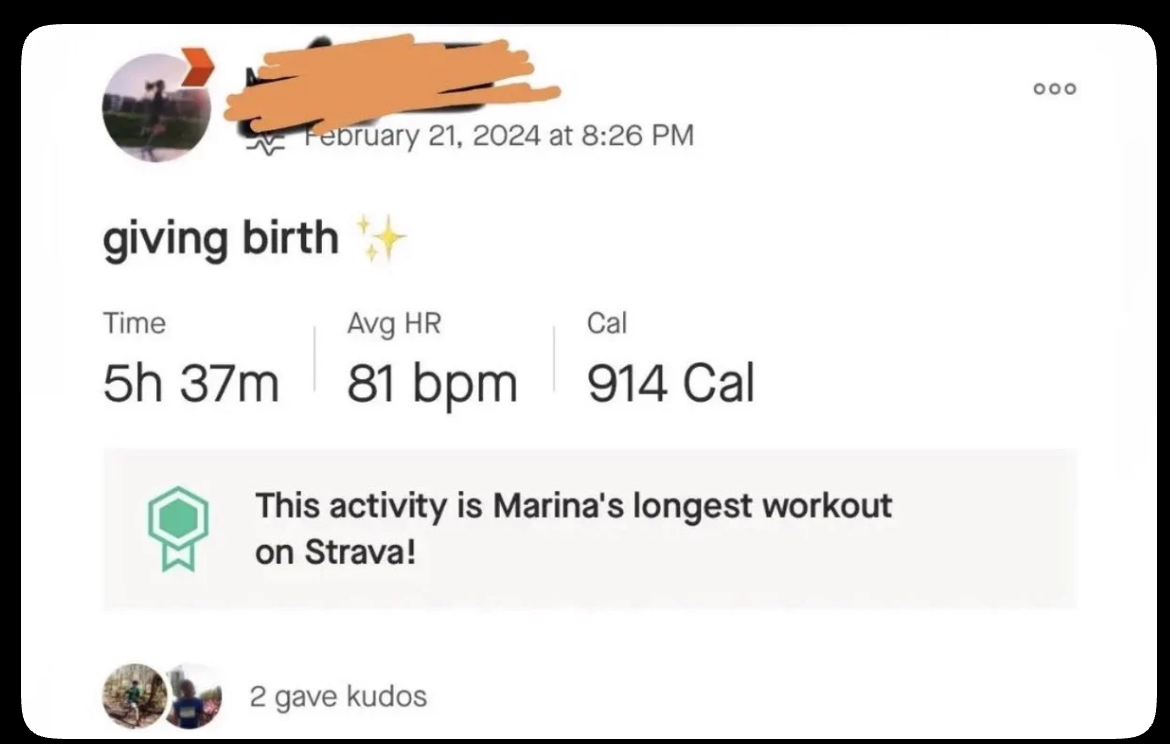
Women are literally Strava-ing childbirth now.
Elite American marathoner Emma Bates logged more than 20 hours of induced labour on Strava before giving birth to her son.
Olympic triathlete Lisa Norden logged her baby’s birth too.
And another woman went viral after Strava labelled her 5-hour-and-37-minute labour her “longest workout on Strava.”
Obviously childbirth is not a workout.
And a Strava file tells us absolutely nothing about what you should lift while pregnant.
But it does expose something interesting.
We spend nine months worrying that exercise might place too much stress on the pregnant body...
while pregnancy itself is an enormous physiological event.
So maybe the question shouldn’t simply be:
“How do I avoid stressing my body?”
Maybe it should be:
“What kind of stress can a healthy pregnant body actually handle?”
Pregnancy changes the rules—but not in the way you might think
Pregnancy changes almost every system involved in exercise.
Blood volume rises.
Your heart is pumping more blood.
Your oxygen demands increase.
Your centre of mass shifts.
Your abdominal wall stretches.
Your pelvic floor is supporting more load.
So yes, the same squat you were doing before pregnancy may eventually feel very different.
A wider stance might feel better.
Your balance may change.
A weight that used to feel easy may suddenly feel heavy.
But that doesn’t automatically make the exercise dangerous.
It just means the body doing the exercise has changed.
So can you keep lifting?
For an uncomplicated pregnancy, current guidance is pretty reassuring: the Canadian pregnancy exercise guidelines recommend that pregnant women without contraindications stay physically active and include both aerobic and resistance training. Previously active women can generally continue exercising, although training may need to be modified as pregnancy progresses.
And the evidence around resistance training is getting stronger.
A 2025 systematic review looked at 50 studies involving more than 47,000 pregnancies.
Resistance training—usually as part of a broader exercise program—was associated with lower odds of gestational hypertension, gestational diabetes, perinatal mood disorders and macrosomia.
So the idea that lifting weights is inherently unsafe during pregnancy?
That doesn’t really hold up.
But there’s a catch.
Most of those studies involved low-to-moderate resistance training.
And if you already lift seriously, that probably isn’t the question you’re asking.
You’re asking:
“What about heavy?”
This is where it gets interesting
Until recently, we had surprisingly little direct evidence looking at genuinely heavy resistance exercise in pregnancy.
A 2025 study finally tested this more directly.
Pregnant participants performed heavy barbell squats, bench presses and deadlifts, both with and without a Valsalva manoeuvre—the breath-hold and brace lifters often use under heavy loads.
Researchers monitored maternal and fetal responses.
The exercises were well tolerated, and fetal heart rate and umbilical blood-flow measures remained reassuring.
That’s fascinating.
But it doesn’t mean:
“Pregnant? Go chase a one-rep max.”
This is still a very small and developing area of research.
What it does challenge is the opposite assumption:
that heavy lifting must automatically be dangerous because it looks intense.
We’re finally starting to test that idea instead of simply repeating it.
What about your heart rate?
This one comes up constantly.
People love a magic number.
“Don’t let your heart rate go above X.”
But pregnancy physiology isn’t that simple.
Your resting heart rate changes. Your cardiovascular response to exercise changes and two women doing the same workout may have completely different heart-rate responses.
Current Canadian guidance focuses primarily on moderate-intensity activity and also suggests using tools like the talk test, rather than relying on one universal heart-rate ceiling.
So Emma Bates logging labour on Strava doesn’t suddenly give us a pregnancy heart-rate target.It just reminds us that the body is capable of handling significant physiological demand.
And what about holding your breath?
Heavy lifting often involves bracing. You inhale. Create pressure through the trunk.
Hold briefly.
Move the weight.
That’s the Valsalva manoeuvre.
Historically, there has been concern that this could interfere with blood flow during pregnancy, but in the recent high-intensity resistance study, the exercises were tolerated both with and without Valsalva.
Again: this is interesting, but not definitive. If breath-holding makes you dizzy or unwell, don’t force it. The Canadian guidelines specifically recommend avoiding excessive Valsalva if it causes light-headedness.
The bigger point is:
not every movement that looks intense is automatically dangerous to a healthy pregnancy.
So, maybe the goal shouldn’t be proving that nothing has changed
There seem to be two extremes when people talk about training during pregnancy.
One says:
“You’re pregnant. Stop lifting.”
The other says:
“Pregnancy isn’t an injury. Change nothing.”
Neither is especially useful.
Pregnancy isn’t an injury but pregnancy also changes a lot.
Maybe you keep deadlifting, but change your stance.
Maybe the bar gets lighter.
Maybe you stop chasing PRs.
Maybe certain movements stop feeling good.
Maybe some weeks you train hard and other weeks you’re exhausted.
That isn’t weakness.
That’s training.
Athletes modify training all the time based on fatigue, injury, competition and recovery. Pregnancy is just a particularly dramatic physiological reason to do the same.
SEE IT IN YOURSELF (if you are pregnant)
Instead of obsessing over whether you can maintain your pre-pregnancy numbers, pay attention to what your body is giving you now.
Does the movement still feel controlled?
Has your balance changed?
Are you experiencing pelvic heaviness, leaking or pain?
Does a familiar load suddenly feel dramatically harder?
Do you feel dizzy or unusually unwell?
Your numbers may change. That doesn’t mean the training stopped working and the strength doesn’t disappear just because there’s less weight on the bar - so keep it up!
You. Truly. Got. This.
A note on safety
This article refers to uncomplicated pregnancies. Certain medical or obstetric conditions can change exercise recommendations, and people exercising well above general pregnancy guidelines should discuss this with a prenatal healthcare provider familiar with high-intensity exercise.
Stop exercising and seek medical assessment for warning signs such as persistent vaginal bleeding, painful regular contractions, fluid leakage, chest pain, persistent dizziness or fainting, or excessive shortness of breath that does not resolve with rest.